Saturday, March 16, 2013

Why Isn't Trade Being Discussed in CO2 Policy Discussions?

Anyone who has followed our Blog knows that we believe in the science of Global Warming/Climate Change, but are not advocates of a U.S. Cap & Trade Carbon Tax. Several recent news stories illustrate this concern.

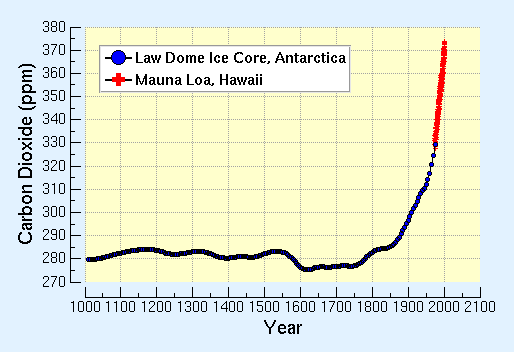
In his State of Union speech, President Obama urged Congress to pursue a bipartisan, market-based solution to Climate Change. Unfortunately, the term "market-based solution" continues to be just defined as a carbon tax. Environmental Interests must demand that "Policy Wonks" do better, rather than creating a flashpoint between Red-State versus Blue-State political ideology.

This week, the U.S. DOE's Energy Information Agency (EIA) released its latest data on U.S. energy related carbon dioxide emissions by State. The below two charts reflect the 8 highest CO2 emission States (red bars) and their percentage (44%) of total U.S. emissions -- where one-half of the Top 8 States are the heart of U.S. Manufacturing (IL, IN, PA, OH) which continues to struggle against the un-level playing field of international trade (especially with China).

Two additional news stories that piqued our interest are reports on increasing coal use in China (as well as India) and the realities facing CO2 emission levels in China.
The next chart puts the above news stories into a global perspective of the importance of international trade in addressing CO2 emissions. Historically, approximately 50% of the U.S. Trade deficit is a result of imported goods manufactured in China and the other 50% from imported oil.
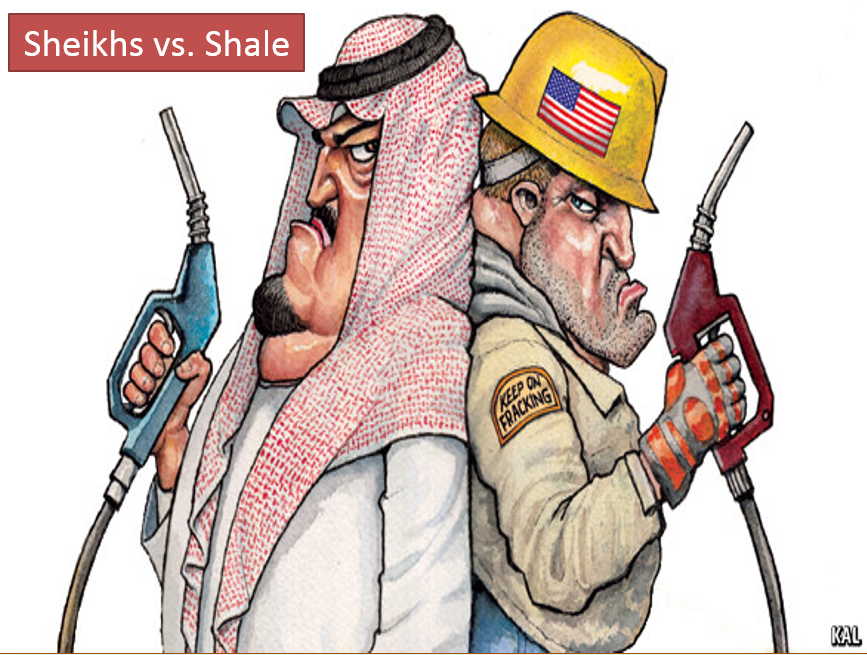
For over 40 years since the Arab oil embargo of 1973, OPEC has conspired to set the global price of oil. If western oil companies tried to do what OPEC does (resulting in a staggering restraint on trade), they would be immediately prosecuted. The producers' cartel, however, can get away with it because its members own 78% of the world's oil reserves and lie beyond our courts.

The next chart illustrates the global C02 consequences of international trade where the flow of CO2 emissions are allocated to the location that goods and services are consumed -- where clearly, "the elephant in the room" is Chinese imports to the U.S.

Just a cursory view of the above flow-chart on Chinese trade leads to a simple question which is never really addressed in any policy dialogue: If Carbon Taxes are levied on U.S. Manufacturing, would global emissions of greenhouse gases really be reduced? Or, would this simply futher displace consumer demand of U.S. manufactured goods (through a higher price) for those produced in China and other developing Countries?
As the term signifies, "Global Warming" is a global problem, not just a U.S. or European problem.

UPDATE: Wall St. Journal Article; N.Y. Times on China's Air Pollution.

Tuesday, January 15, 2013

Gas Vs. Ethanol Prices -- 2012 Review

The below pink line is the commodity/wholesale price of 100% ethanol (E-100). But as a N.Y. Times story explains, ethanol gets less MPG than gasoline. The green line adjusts (increases the price) for the lower energy efficiency of ethanol, allowing an "Apples to Apples" comparison with the wholesale price of gas (blue line). The red line is the average of all U.S. retail pump prices of regular grade gasoline.
A good "Rule of Thumb" for U.S. consumers in making ethanol decisions at the pump (ethanol blends above 10%, such as E-85) is that used in Brazil. In Brazil, flex-fuel drivers generally buy gasoline when the price of ethanol is more than 70% of gasoline, and buy ethanol when the comparable price is lower. For example, during the Spring, U.S. ethanol was a good deal (as low as 65% of the wholesale RBOB gasoline price). But for most of the year, ethanol has been more expensive on a MPG adjusted basis.
It should be noted however, that this current "Rule of Thumb" may soon change as a result of on-going breakthroughs in engine engineering design (e.g., Ricardo Engines Turbo Boost). We will address this improving fuel efficiency of flex-fuel engines (as well as aviation bio-fuels being tested by the U.S. Military) in future blog posts.

The below chart gives an illustration of just how significant these improvements in engine efficiency could be -- where the only data changed from the original chart is the use of efficiency data that Ricardo Engines' is currently achieving in field tests -- where adjusted ethanol prices are a clear winner.

Retail Gasoline Prices: The below map shows the current national average (above chart's red line) by region.

Current Retail Gasoline Prices by Region
At year-end 2012, wholesale and retail gas prices were about equal to a year ago (2¢ higher) with ethanol trading 7¢ per gallon lower.

Ethanol Prices: A simple linear regression statistical analysis shows that U.S. ethanol prices can be almost entirely explained (a R2 of .91) by the commodity price of #2 yellow corn (which is not used for human consumption). The extreme volatility in ethanol prices since July is the result of a series of initial over-reactions and then corrections in corn futures markets as to the actual severity of the drought in the Midwest on crop yields. As a result of this price increase, ethanol production levels have decreased up to 20% since July. With low or negative profit margins, many ethanol plants have either reduced output or temporarily shut down entirely.

As the below chart reflects, high corn feedstock costs are clearly having an adverse impact on U.S. ethanol production. The levelized (orange line) represents the theoretical monthly bio-fuel production level necessary to meet the yearly Renewable Fuel Standard's requirement of 13.95 billion gallons of bio-fuel use for 2012. In every month except January, actual production (purple line) was below the orange line.

Because of this shortfall in new bio-fuel production, the RFS was met using a combination of 3 market mechanisms: (1) Using RIN Credits from the previous year (where bio-fuel use exceeded RFS requirements); (2) Drawing down of existing bio-fuel inventories; (3) Bio-fuel imports (from Brazil).

During 2012, we agree with two studies (here and here) that ethanol use has had a negligible impact on retail gas prices. This is because the greatest use of ethanol is a 10% or less blend with gasoline (E-10). Year to date, 10% of the cumulative price differential between the wholesale price of ethanol (adjusted for efficiency) and gasoline is ~3¢ per gallon. Also recognizing that without ethanol, fuel blenders would have to substitute higher cost sources of octane additives, the price differential is probably only about 1¢ per gallon.

However long term, Supporters of ethanol must recognize a clear reality. As long as the adjusted price of ethanol (green line) is higher than the wholesale price of gasoline (blue line), ethanol use will always be criticized and lack acceptance by the U.S. Public even at low E-10 blend levels.

This lower cost can happen in two ways: (1) lowering ethanol's production cost through cheaper feedstocks and better conversion technologies (e.g., cellulosic enzymes); (2) greater auto engine efficiency utilizing ethanol's higher octane levels (smaller engines using turbo-boost).

The Renewable Fuel Standard: The recent volatility and price spikes of ethanol from the Mid-western drought is a good illustration that the future of ethanol is not from corn. Feedstock and production technology diversity is needed from other sources (sorghum, cellulosic). In passing the Renewable Fuels Standard requiring ethanol blending with gasoline, Congress recognized this point by capping the use of corn feedstocks (which current ethanol production has almost approached).

For all the criticism that ethanol use receives, what is generally lost by the general public is the amazing success story that has been so quickly achieved in accomplishing national goals for greater energy security and job creation. This achievement would not have been possible without using the existing corn industry's infrastructure in the Mid-west.

Did you know?: The Renewable Fuels Standard has resulted in a fundamental shift in gasoline formulation. The refining industry has now moved to using predominantly 84 octane "conventional" gasoline and then blending it with higher octane ethanol (around 113) to produce the 87 octane gasoline that is the most popular level with consumers. This change in refining practices is not easily reversed. While other octane enhancers could be used, ethanol's price make it the current lowest cost octane source of choice by refiners.

Data Sources:
Per numerous Sources (DOE, EPA), E-10 (10% ethanol) has ~3% less efficiency than E-0 (zero ethanol). Ethanol on a "net basis" has less BTU content, but higher octane.

-- Wholesale Ethanol prices are from the Chicago Board of Exchange.
-- Wholesale Gasoline prices are from the Chicago Board of Exchange.
-- Retail Gasoline prices are from Bloomberg's survey of national gas prices.
-- Corn Feedstock costs are calculated from Chicago Board of Exchange.
-- Distiller's Dried Grains (DDG) Futures (100 short tons) from CBOE.

-- Wholesale Gasoline Real Time Daily Trading Data.
-- Wholesale Ethanol Real Time Daily Trading Data.

Sunday, October 21, 2012

Current Gas Vs. Ethanol Prices (Oct. 19, 2012)

The below pink line is the commodity/wholesale price of 100% ethanol (E-100). But as a N.Y. Times story explains, ethanol gets less MPG than gasoline. The green line adjusts (increases the price) for the lower energy efficiency of ethanol, allowing an "Apples to Apples" comparison with the wholesale price of gas (blue line). The red line is the average of all U.S. retail pump prices of gasoline.
Retail Gasoline Prices: As the below map shows, the current national average (above chart's red line) is skewed upward by spikes in Western prices caused by current refinery problems in California (fires, questionable maintenance).

Current Retail Gasoline Prices by Region
The good news is that for most of the U.S., each October marks the annual date where gasoline refiners start switching production to cheaper fuel blends for cooler weather. During summer months, higher cost blends are used to reduce air pollution (e.g., smog). Thus excluding any unforeseen major market event (e.g., war in the Middle East) consumers should expect to see a decrease in pump prices through next Spring.

Ethanol Prices: A simple linear regression statistical analysis shows that U.S. ethanol prices can be almost entirely explained (a R2 of .91) by the commodity price of #2 yellow corn (which is not used for human consumption). The extreme volatility in ethanol prices since July is the result of a series of initial over-reactions and then corrections in corn futures markets as to the actual severity of the drought in the Midwest on crop yields. As a result of this price increase, ethanol production levels have decreased ~20% since July. With low or negative profit margins, many ethanol plants have either reduced output or temporarily shut down entirely.

During 2012, we agree with two studies (here and here) that ethanol use has had a negligible impact on retail gas prices. This is because the greatest use of ethanol is a 10% or less blend with gasoline (E-10). Year to date, 10% of the cumulative price differential between the wholesale price of ethanol (adjusted for efficiency) and gasoline is less than 3¢ per gallon. Also recognizing that without ethanol, fuel blenders would have to substitute higher cost sources of octane additives, the price differential is probably only about 1¢ per gallon.

However long term, Supporters of ethanol must recognize a clear reality. As long as the adjusted price of ethanol (green line) is higher than the wholesale price of gasoline (blue line), ethanol use will always be criticized and lack acceptance by the U.S. Public even at low E-10 blend levels.

This lower cost can happen in two ways: (1) lowering ethanol's production cost through cheaper feedstocks and better conversion technologies (e.g., cellulosic enzymes); (2) greater auto engine efficiency utilizing ethanol's higher octane levels (smaller engines using turbo-boost).

The Renewable Fuel Standard: The recent volatility and price spikes of ethanol from the Mid-western drought is a good illustration that the future of ethanol is not from corn. Feedstock and production technology diversity is needed from other sources (sorghum, cellulosic). In passing the Renewable Fuels Standard requiring ethanol blending with gasoline, Congress recognized this point by capping the use of corn feedstocks (which current ethanol production has almost approached).

For all the criticism that ethanol use receives, what is generally lost by the general public is the amazing success story that has been so quickly achieved in accomplishing national goals for greater energy security and job creation. This achievement would not have been possible without using the existing corn industry's infrastructure in the Mid-west.

Did you know?: The Renewable Fuels Standard has resulted in a fundamental shift in gasoline formulation. The refining industry has now moved to using predominantly 84 octane "conventional" gasoline and then blending it with higher octane ethanol (around 113) to produce the 87 octane gasoline that is the most popular level with consumers. This change in refining practices is not easily reversed. While other octane enhancers could be used, ethanol's price make it the current lowest cost octane source of choice by refiners.

Data Sources:
Per numerous Sources (DOE, EPA), E-10 (10% ethanol) has ~3% less efficiency than E-0 (zero ethanol). Ethanol on a "net basis" has less BTU content, but higher octane.

-- Wholesale Ethanol prices are from the Chicago Board of Exchange.
-- Wholesale Gasoline prices are from the Chicago Board of Exchange.
-- Retail Gasoline prices are from Bloomberg's survey of national gas prices.
-- Corn Feedstock costs are calculated from Chicago Board of Exchange.
-- Distiller's Dried Grains (DDG) Futures (100 short tons) from CBOE.

-- Real Time Daily Trading Data on energy products.

Friday, September 28, 2012

High Oil & Gas Prices -- The Real Issues.

For decades, politicians have been promising America oil independence AND lower gasoline prices. But instead of more promises, we need some straight talk on expectations, global realities, and the tough choices we face. The real policy issues that drive today's high oil prices are the consequences of war and a suffocating federal debt -- anything else is a diversion.
 
Can We "Drill Baby Drill" to $2 Gas?: A major diversion used in campaign rhetoric on high gas prices is supposedly simple Econ 101 -- Supply and Demand.   Under this argument, if U.S. environmental regulations were reasonable allowing more oil drilling, the increased supply would reduce the price of gas to a $2 range. FACT CHECKing this claim should be really easy by just looking at Canada -- as they have historically produced much more oil than Canadians consume. But Whoops! -- gasoline prices in Canada exactly track those in the U.S. (as they also do in other free market "net oil exporting countries" such as Norway).

On the flip side of political rhetoric, President Obama is taking credit that U.S. oil production is now the highest since 1998. Is this credit deserved?

Of course not. As an article from the Canadian "Oil Patch" explains, the reason oil exploration and production is currently booming in North America is because of high prices. For example, extracting oil from tar sands (the source of the Keystone pipeline project) and other unconventional sources can cost up to $40 a barrel. Without high oil prices, tar sands would not be economic compared to Middle Eastern oil (which costs 50¢ to $2 per barrel to extract).

While there are tremendous benefits of increasing domestic oil production (e.g., creation of good jobs, greater energy security, decreasing the U.S. trade deficit) -- an expectation of meaningful reductions in oil and gas prices isn't one of them. Simply stated, gasoline prices will always be driven by the world commodity price of oil.

The Real Price Drivers: After decades of stable oil prices, beginning in the early 2000's the combination of several drivers have fundamentally changed global oil markets:
(1) Ongoing war and political unrest in the Middle East; (2) Devaluation of the U.S. Dollar; (3) A dramatic increase in oil demand from developing economies; and possibly
(4) The unprecedented levels of money flowing into oil futures speculation.

A picture can be worth a thousand words. As the above chart illustrates, there have been dramatic consequences from 10 years of war, bad behavior on Wall Street, and the accumulation of massive debt under President Bush and Obama (devaluing our currency). These are the true drivers of high oil prices, not environmental regulations.

War in the Middle East:: Many oil market analysts believe a war between Iran and Israel would immediately send oil prices to $150 per barrel (and already creating a significant risk premium in oil prices). If an Iran/Israeli conflict were to spread throughout the Region (which supplies ~60% of the World's oil market), the consequences on prices would be catastrophic. With the possibility of $6, $8, $10 U.S. gas prices (fill in the blank as your guess is as good as anyone else), foreign policy is very much a domestic economic issue in the U.S. Presidential campaign.

Devaluation of U.S. Dollar: Beginning with the Bush Administration (in 2002) and continuing with Obama, a significant devaluation of the U.S. dollar has occurred. While there are numerous reasons for this, they are generally linked to Federal monetary policies to finance huge federal budget deficits and to spur a weak economy.

With currency devaluation the cost of imported goods (such as oil) increases as the purchasing power of the U.S. dollar is less. In simplistic terms (all things equal), ~33% of the increase in the price of gasoline since 2002 could be explained by currency devaluation. Many market analysts argue that as a result of world central banks flooding the market with money (to finance budget deficits), its not that oil is expensive -- but its money that is cheap.

Increased Demand for Oil from Developing Economies: A major driver in higher oil prices is/will be the continuing dramatic increase in oil demand from developing countries such as China and India -- something that no President has any control over.
[British Petroleum (BP) has an excellent 2 minute picture overview of what's occurring in world energy markets on YouTube.]

Oil Futures Speculation & Oil/Gas Prices: Typically, a belief in whether excessive market speculation is causing a significant rise in oil prices depends on what "Political Tribe" you belong to. Democrats believe oil futures markets should be regulated more -- and are raising the current price of gas between $7 (small car) to $14 (truck) when you fill up. Republicans believe this is paranoia and oppose additional regulation (Dodd-Frank).

Thankfully, there is an Easy Button to resolve this. Even if financial market speculation is adversely impacting oil prices, its an "effect" not a "cause". If the issues of war and federal debt were resolved, this would pretty much eliminate the conditions that drive excessive financial speculation.

The Final Question: After listening to all the campaign rhetoric and attack ads, everyone should ask the question:   "What do environmental regulations have to do with war and the Federal debt level, the true drivers of high oil prices?" The answer is simple -- they don't.

Become a Facebook Friend and Follow Our Future Blogs on:

Sunday, July 08, 2012

Current Ethanol Vs. Gas Prices (July 6, 2012)

The below pink line is the commodity/wholesale price of ethanol. But as a N.Y. Times story explains, ethanol gets less MPG than gasoline. The green line adjusts (increases the price) for the lower energy efficiency of ethanol, allowing an "Apples to Apples" comparison with the wholesale price of gas (blue line). The red line is the average U.S. retail pump price of gasoline.
Current Retail Gasoline Prices by Region
The Bad News: On July 6 -- the price of ethanol (green line) was a whopping ~71¢ per gallon higher than gas on a wholesale price comparison (blue line). Incredibly, this price is higher than the retail price of gas (which includes taxes, transportation costs).

Not as Bad News: Most gasoline contains 10% or less ethanol (E-10). Thus, as this high cost ethanol is blended with gasoline, most people could be paying ~7¢ per gallon more when they fill up.

Better News: The current "price premium" between wholesale ethanol and gasoline has not existed for the entire year. From March to May, ethanol prices (green line) were less than gas. On a year-to-date basis, the price premium for E-10 is ~1.5¢ per gallon.

Hopeful Consumer News: U.S. ethanol inventories remain at near record high levels (excess supply). If inventories remain high, the current price premium may never fully make it to consumer's pocketbooks. Rather, ethanol companies may have to "eat" some of this higher cost, reducing their margin and profit levels to sell product.

What's Going On?: Prior to June, ethanol prices were trending lower in expectations of reduced ethanol feedstock costs from the largest corn crop planted in the U.S. since 1937. However, recent drought conditions in many mid Western States have caused commodity corn futures prices to skyrocket.

Currently, almost all ethanol in the U.S. is produced from corn feedstock. Until the Industry transforms itself to next generation feedstocks (e.g., sugar cane, sweet sorghum, cellulosic sources as is being done in Florida), ethanol prices will be highly dependent on the market price of corn. (1) (2)

(1) A simple linear regression of corn (x) and ethanol (y) prices using 2012 data resulted in a correlation R2 of .8378 with a dependent variable value of y= 0.8893x + 0.7536.
(2) "Corn Feedstock Cost" is the estimated "Net Costs" reflecting co-product of DDGS (Distiller Grains). The calculation methodology is simplistic, using 70% of commodity corn prices.

Data Sources:
Per numerous Sources (DOE, EPA), E-10 (10% ethanol) has ~3% less efficiency than E-0 (zero ethanol). Ethanol on a "net basis" has less BTU content, but higher octane.

-- Wholesale Ethanol prices (pink line) are from the Chicago Board of Exchange.
-- Wholesale Gasoline prices (blue line) are from the Chicgo Board of Exchange.
-- Retail Gasoline prices (red line) are from Bloomberg's survey of national gas prices.
-- Corn Feedstock costs (orange line) are calculated from Chicago Board of Exchange.
-- Dried Distillers Grains data from Chicago Board of Exchange.

-- Real Time Daily Trading Data on energy products.

Friday, June 22, 2012

Why Oil &Gas Prices are High in 5 Pictures (Updated)

Update: British Petroleum (BP) has released an excellent 2 minute overview using pictures of what's occurring in world energy markets on YouTube. Also, World oil prices (Brent) have dropped to $89 per barrel. (1)

History: After decades of stable oil prices, beginning in the early 2000's the combination of several drivers have fundamentally changed global oil markets: (1) Ongoing war and political unrest in the Middle East; (2) Devaluation of the U.S. Dollar; (3) A dramatic increase in world oil consumption from developing economies; and possibly, (4) The unprecedented levels of money flowing into oil speculation markets since banking deregulation.

Devaluation of U.S. Dollar: Beginning with President Bush's Administration (in 2002) and continuing under President Obama, a significant devaluation of the U.S. dollar has occurred. With currency devaluation the cost of imports (such as oil) increases. In simplistic terms (all things being equal), ~33% of the increase in the price of gasoline could be explained by currency devaluation.
Increased Demand for Oil from Developing Economies: A major driver in higher oil prices is/will be the continuing dramatic increase in oil demand from developing countries such as China and India -- something that no President has any control over.
Oil Futures: If you don't understand financial futures/derivatives, don't feel alone. When Warren Buffet was asked about what he thinks of derivatives he responded, "I don't understand them". For most people, an opinion on futures trading will depend on which Tribe they belong to (Democrats believe they should be regulated better, Republicans are anti-regulation). While the impact on oil prices from futures trading may be unclear, one fact is crystal: Their use exploded in the early 2000's after banking de-regulation (where now ~60% to 70% of trading volume is by financial institutions).
But the above chart is just the tip of the iceberg, where the vast majority of futures trading is unreported (OTC markets). The problem is the lack of transparency/disclosure -- nobody really knows or can know if excessive speculation is occurring.

Can We "Drill Baby Drill" to $2 Gas?: A central theme in this year's election campaign rhetoric on high gas prices is supposedly simple Econ 101 -- Supply and Demand. Under this argument, if environmental regulations were reasonable allowing more oil drilling, the increased supply would reduce the price of gas to a $2 range. Since the economics are so simple, we should be able to just look at the pump price savings in Canada -- as they produce much more oil than Canadians consume. But Whoops! -- gasoline prices in Canada exactly track those in the U.S.

Conclusion: While there are numerous benefits of increasing domestic oil production (e.g., creation of good jobs, greater energy security, improving the U.S. trade deficit) -- expectations of meaningful reductions in oil and gas prices isn't one of them. Simply stated, gasoline prices will always be driven by the world price of oil (an internationally traded commodity).

Extra Credit: If you want to be an A+ Student on market drivers for oil and gasoline prices, read this article from the Canadian "Oil Patch". The reason oil exploration is currently booming in Canada and the U.S. is because of high prices. For example, extracting oil from tar sands (the source of the Keystone project) can cost up to $40 per barrel. Without high oil prices, tar sands would not be economic compared to Middle Eastern oil (which costs 50¢ to $2 per barrel to extract).

Saturday, May 26, 2012

Current Ethanol Vs. Gas Prices (May 25, 2012)

Tracking gasoline prices versus ethanol prices. The pink line is the commodity price of ethanol (which has less efficiency than gas, E-0). The green line line adjusts for this lower efficiency, allowing an "Apples to Apples" comparison with the commodity RBOB price of gas (the blue line). The red line is the average retail price of gasoline in U.S.

As of May 25, 2012 -- ethanol (adjusted for efficiency) is 8¢ per gallon higher than gasoline on a wholesale price comparison. However, since most gasoline contains only 10% or less ethanol (E-10), this price differential at the pump is currently eight tenths of a penny (.8¢).


Current Retail Gasoline Prices by Region
Data Sources:
Per numerous Sources (DOE, EPA), E-10 (10% ethanol) has ~3% less efficiency than E-0 (zero ethanol). Ethanol on a "net basis" has less BTU content, but higher octane.

-- Wholesale Ethanol prices (pink line) are from the Chicago Board of Exchange.
-- Wholesale Gasoline prices (blue line) are from the Chicgo Board of Exchange.
-- Retail Gasoline prices (red line) are from Bloomberg's survey of national gas prices.

-- Real Time Daily Trading Data on energy products.